
In a kitchen or service environment, your fabric choice isn’t just about aesthetics: it’s about how well your uniform holds up under pressure, literally. Heat, moisture, long hours, and repeated washing. The right fabric makes all the difference.
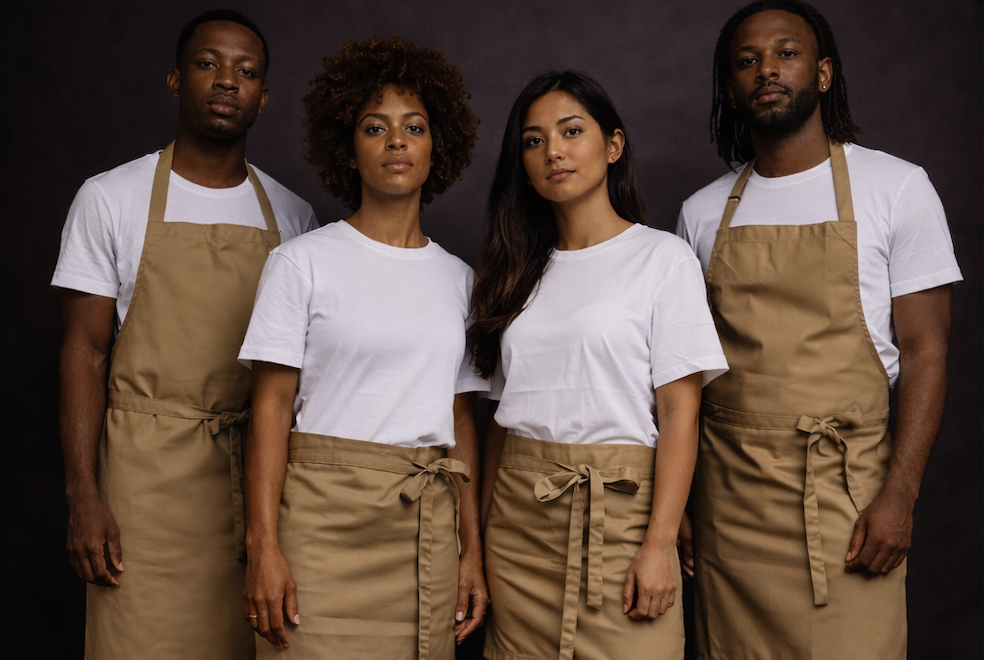
When outfitting a hospitality team, it’s tempting to focus on colour, cut, and branding, and those things absolutely matter. But the conversation that doesn’t happen often enough is about fabric. Because the best-looking uniform in the world falls flat if it’s uncomfortable to wear, difficult to clean, or falls apart after twenty washes.
Here’s what you need to know.
The Golden Rule for Kitchen & Service Uniforms: Absorbency Matters
In a kitchen or active service environment, your team sweats. There’s steam, heat, and constant movement. A fabric that traps heat and moisture isn’t just uncomfortable, it affects how your team performs and how they look by the end of a shift.
The right uniform fabric should be able to absorb moisture, allow the body to breathe, and still look presentable after a full service.
With that in mind, let’s look at the main contenders.
Cotton: The Classic Choice
Cotton is the go-to for a reason. It’s natural, it breathes well, it absorbs moisture effectively, and it’s comfortable against the skin even during long, hot shifts. In a kitchen environment, cotton’s natural absorbency is a genuine asset, it draws sweat away from the body and doesn’t trap heat the way synthetic fabrics can.
It’s also easy to launder, which matters enormously in a hospitality context where uniforms are washed frequently at high temperatures. And from a sustainability perspective, natural cotton is biodegradable and generally more environmentally friendly than synthetics.
The trade-off? Cotton wrinkles. It can shrink if not washed correctly, and it tends to show wear faster than blended fabrics. For kitchen uniforms where presentation matters alongside practicality, this can be a consideration.
Poly-Cotton Blend: The Practical Middle Ground
A poly-cotton blend (typically 65% polyester, 35% cotton: though ratios vary) takes the best of both worlds. The cotton component keeps the fabric breathable and absorbent; the polyester component adds durability, wrinkle resistance, and shape retention.
For hospitality uniforms that need to look sharp service after service, a poly-cotton blend is often the most practical choice. It holds its colour well, resists shrinking, and stays looking pressed even after repeated washing, which is a real operational advantage when you’ve got a team to outfit.
It’s worth noting that higher cotton content means better breathability and absorbency. A 65/35 cotton-poly blend will perform differently from a 35/65 cotton-poly blend. For hot kitchen environments, lean towards higher cotton percentages.
Linen: The Premium Option
Linen is having something of a moment in hospitality, and for good reason. It’s extraordinarily breathable: arguably more so than cotton, and it has a natural texture that looks elegant and considered. For front-of-house staff in restaurants, boutique hotels, or high-end cafés, a linen uniform signals quality.
Linen is also highly absorbent. It can absorb moisture without feeling damp, and it becomes softer with each wash rather than wearing out the way some synthetics do.
The caveat: linen creases significantly. If a polished, unwrinkled appearance is critical for your service team, linen requires more care, or a linen-blend fabric that smooths out some of the wrinkle-prone qualities.
A Quick Reference Guide
To summarise how these fabrics compare in a hospitality context:
- Cotton: High absorbency, excellent breathability, easy care. Best for kitchen and back-of-house. Wrinkles more than blends.
- Poly-Cotton Blend: Good absorbency, wrinkle-resistant, durable. Best all-rounder for both kitchen and service teams. Higher cotton ratio = better for hot environments.
- Linen: Exceptional breathability and absorbency, premium aesthetic. Best for front-of-house in upscale settings. Requires more care to maintain appearance.
Kitchen vs. Service: Different Demands, Different Choices
It’s worth thinking about kitchen and service uniforms slightly differently. Back-of-house kitchen staff are dealing with heat, open flames, steam, and spills: here, absorbency and durability are paramount. A cotton or high-cotton poly-cotton blend is the smart choice.
Front-of-house service staff face a different challenge: they need to look impeccable throughout a service while still being comfortable and able to move. A poly-cotton blend or a quality linen (for the right brand aesthetic) works well here: something that looks sharp even as the evening wears on.
Fabric is not a secondary consideration: it’s foundational. The right fabric choice means your team is comfortable enough to perform at their best, your uniforms last longer (which matters for your bottom line), and your brand looks consistent and professional service after service.
At Fuse It, we work with hospitality businesses to source uniforms in fabrics that work as hard as your team does. Whether you’re outfitting a kitchen brigade or a front-of-house service team, we’ll help you find the right fabric, the right cut, and the right look for your brand.